Creating a Generative AI Policy for Your Course: A Step-by-Step Guide
This guide was created by Dr. Brianna August-Rae, Assistant Professor in the Department of Communication & Storytelling, and CTE Faculty Affiliate.
Download a pdf version of this guide here.
Last updated May 7, 2026
What’s in This Guide?
This short guide provides an at-a-glance overview of how to thoughtfully incorporate a Generative AI (GenAI) policy into your course. Below, we provide a brief overview of each step. Further details and helpful resources are included within the guide.
Step 1 - Build GenAI Literacy
Get familiar with what GenAI is, how it works, and why it matters for teaching. This
section suggests starting points for developing your own AI literacy so you can make
informed choices about your syllabus policy.
Step 2 - Reflect on Learning Outcomes
Before writing a policy, consider how GenAI might help—or hinder—students in meeting
your course goals. This step encourages rethinking learning outcomes in light of emerging
workforce needs and Bloom’s Taxonomy 2.0.
Step 3 - Choose Your Policy Approach
Decide whether to prohibit, limit, or encourage GenAI use in your course. A simple
traffic light metaphor helps clarify your stance:
🔴 Prohibit all use
🟡 Allow limited use with clear boundaries
🟢 Encourage use with reflection and attribution
Step 4 - Review the Building Blocks of a GenAI Syllabus Policy
We provide a checklist of what to include in your syllabus language: a clear definition,
specific rules about what’s allowed and what isn’t, and consequences for policy violations,
as well as optional components like rationale and citational practice guidelines.
Appendix A - Sample Policies
Three sample syllabus policies (Red, Yellow, Green) are provided. You are invited
to tailor one of the sample policies to your context.
Appendix B - Sources & Resources
A curated list of helpful tools, articles, and institutional guides to support your
ongoing learning and implementation.
-
Step 1: Build Your Own GenAI Literacy
Before drafting your syllabus policy, take time to understand how GenAI tools work and how they might affect your classroom.
- Start Here: Review ETSU’s Written Guidance for Ethical Use of Generative AI developed by the Generative AI Task Force. Note the key principles:
- Transparency & disclosure
- Privacy & data protection
- Human oversight & accountability
- Staying current & informed
- Suggested Resources:
- Composition @ College of DuPage offers suggestions for how to build your GenAI literacy (see Recommendation 1)
- Read Hibbert et al.’s “A Framework for AI Literacy” (2024)
Watch “An Introduction to AI Tools for Educators” by Cornell’s Center for Teaching Innovation
- Start Here: Review ETSU’s Written Guidance for Ethical Use of Generative AI developed by the Generative AI Task Force. Note the key principles:
-
Step 2: Reflect on Course Learning Outcomes (LOs)
Our course design—from classroom policies, to content, to assessment—should be guided by the learning outcomes we aim to cultivate. Therefore, to determine what kind of GenAI syllabus policy is the best fit for your course, critically analyze how GenAI could help, hinder, or transform your course LOs.
- Analyze Impact by Subject Area:
- Use Cornell’s “Generative Artificial Intelligence for Education and Pedagogy” to explore GenAI’s implications for:
- Courses that develop writing as a skill
- Courses that center creative expression (e.g., music, art)
- Social sciences courses
- STEM courses
- Programming courses
- Use Bloom’s Taxonomy to Guide Decisions:
- Consult Oregon State’s Bloom’s Taxonomy Revisited 2.0 [Figure 1] as an example of how GenAI might complement learning or change what type of skills should be emphasized at each level of Bloom’s Taxonomy
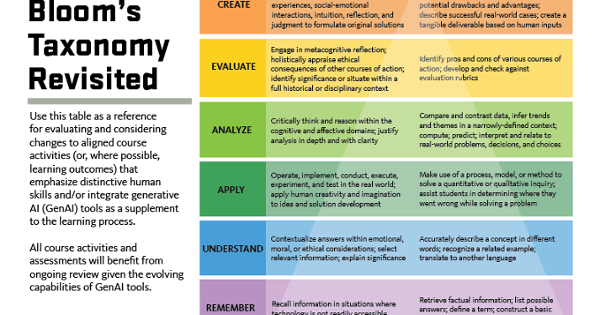
Figure 1. Bloom’s Taxonomy Revisited 2.0 via https://ecampus.oregonstate.edu/faculty/artificial-intelligence-tools/blooms-taxonomy-revisited/
- Revisit Learning Outcomes:
- Consider revising LOs to emphasize higher-order thinking, creativity, and critical
GenAI literacy
- Consider the Degree of GenAI use Fits Your Context
- GenAI tools can be used in a variety of ways. Consider which uses/degrees of GenAI involvement may be appropriate for your course’s context and LO’s
- Figures 2 & 3 contain diagrams that help you think through which (if any) forms of GenAI use you will permit
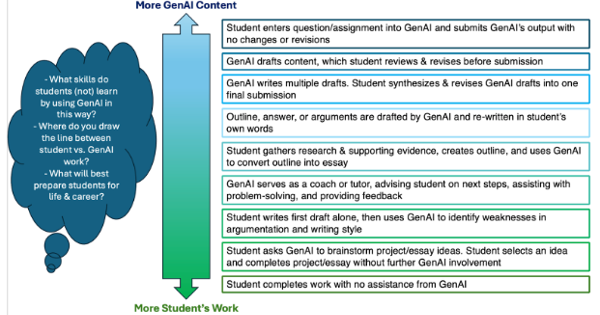
Figure 2. Spectrum of GenAI vs. Human Work This graphic was adapted from Matt Miller’s graphics “It’s time to rethink ‘plagiarism’ and ‘cheating’” and “Classroom AI use”

Figure 3. AI Assistance in Student Assignments by Bill Barnum, via https://www.linkedin.com/posts/bill-barnum-91a59a17_aiineducation-edtech-chatgpt-activity-7073135603386617856-CQDM
- Suggested Resources:
- Read the archived blog post “Advancing meaningful learning in the age of AI” for additional reflections/considerations about GenAI’s implications for Bloom’s Taxonomy
- Review LOs for GenAI developed by the Sentient Syllabus Project
Consider assigning projects/activities that incorporate GenAI– suggestions can be found under “Design Assignments to Work with AI” from NC State, Cornell’s “Creative Responses to Generative AI” page, and in Mollick’s (2023) article “Assigning AI: 7 ways of using AI in class”
- Analyze Impact by Subject Area:
-
Step 3: Choose Your Course’s GenAI Usage Policy
A traffic light model may clarify your decision.
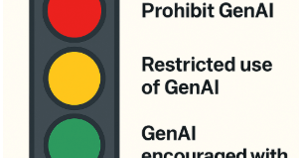
🔴 Red – Prohibit Use:
GenAI is not allowed. Emphasize development of original thinking and skill-building.🟡 Yellow – Limited Use:
GenAI may be used for specific tasks (e.g., brainstorming), but not others (e.g., drafting responses). Clear boundaries and citation required.🟢 Green – Encourage with Attribution:
GenAI is welcomed, with expectations for transparency, reflection, and attribution.🔴🟡🟢Sample syllabus policies are provided in Appendix A
-
Step 4: Draft Your Syllabus Policy
Every GenAI policy should include the following:
Required Components:
- Definition of GenAI. Your policy should clearly outline what does (not) count as GenAI. You may choose to use or adapt one of the sample definitions from Figure 4.
- Permissible and Prohibited Uses. Be specific and provide examples.
- Responses to Misuse. Clearly outline what happens if students use GenAI in ways that don’t align with your policy. Emphasize learning and fairness over punishment, and try to keep the tone warm.
Recommended Components:
- Rationale for policy
- Encouragement to ask questions
- Reminder about GenAI’s limitations (e.g., bias, inaccuracy)
- Guidelines for citation and documentation
- Suggestions for documenting original student work
Figure 4. Sample Definitions of Generative AI
Definition
Source
Generative AI refers to algorithms that can create new content, whether it be text, images, audio, or other data types, that resembles a given set of input data
Oluwagbenro, 2024
Generative artificial intelligence is a subset of AI that utilizes machine learning models to create new, original content, such as images, text, or music, based on patterns and structures learned from existing data.
Center for Teaching Innovation at Cornell University, accessed 7/15/25
Artificial intelligence systems that are capable of creating new content or data, including text, images, audio, or video, when prompted by an individual.
ETSU “Use of artificial intelligence technologies for instructional and assignment purposes” 2/21/25
Generative AI refers to tools that use artificial intelligence to create new content—such as text, images, code, or media—in response to user input. Examples include ChatGPT, Grammarly Premium, DALL·E, Midjourney, Claude, and AI features in apps like Microsoft Copilot. These tools count as Generative AI when they help you generate, rewrite, or complete work.
The following are not considered Generative AI for this course:
- Basic grammar/spell checkers (e.g. Word Editor)
- Search engines (e.g. Google)
- Citation tools (e.g. Zotero, EasyBib)
- Accessibility tools (e.g. screen readers)
- Calendar and organization apps
OpenAI. (2025). Definition of Generative AI for course syllabi. ChatGPT. https://chat.openai.com
-
APPENDIX A - SAMPLE POLICIES
- You may tailor one of the three sample templates (Red, Yellow, Green) to your course.
Use language that matches your discipline and pedagogy.
🔴 RED – PROHIBIT
Definition: Generative AI (GenAI) refers to tools that generate written, visual, audio, or code-based content in response to a user prompt. Examples include ChatGPT, Claude, Gemini, Grammarly’s Premium/AI features, and others.
Policy: GenAI use is not allowed in this course for any activity or assignment. This includes, but is not limited to:
- Submitting any AI-generated content
- Using GenAI to brainstorm, outline, or revise
- Uploading work to AI tools for feedback or editing
- Using AI to summarize or analyze readings
Rationale: This course is designed to build foundational academic skills in original thinking, writing, and research. Using GenAI to complete coursework bypasses these learning processes and undermines your independence and skill development. To ensure fairness and uphold academic integrity, all assignments must be your own unaided work.
Responses to Misuse: Using GenAI in ways that go against this policy may regrettably result in [a reduced grade, the need to revise and resubmit your work,] or other steps in line with ETSU’s academic integrity process.
Reminder: If you’re unsure whether a tool counts as GenAI or whether a use is permitted, ask your instructor before submitting your work.
🟡 YELLOW – LIMITED USE
Definition: GenAI includes tools that generate or suggest content (text, audio, visuals, or code) in response to a user’s prompt. Examples include ChatGPT, Grammarly Premium and AI features, Claude, Gemini, and more. Basic grammar/spell checkers (e.g., Word editor), search engines, and citation managers are not considered GenAI for this course.
Policy: You may use GenAI for brainstorming, receiving feedback, or revising original work.
However, do not use it to:- Draft outlines or responses to essay, exam, or homework questions
- Outsource critical thinking or analysis (e.g., asking GenAI to summarize a reading so that you do not have to complete the reading)
- “Humanize” text to circumvent GenAI detection software. Use of tools such as Humanize AI, Write Human, Undetectable AI, etc. is not permissible
Citation Requirement: In accordance with ETSU Generative AI guidance, specifically the principle of transparency and disclosure, you are required to disclose any and all use of GenAI in course assignments. If you use GenAI, include a “GenAI Reference Page” with the prompt(s) and the AI-generated output(s). A template is available on D2L. [Note: You would want to create your own template here based on how you require students to cite GenAI. See this example for a COMM 5300 Fall 2025 class here.]
Rationale: I recognize that GenAI tools can support learning. However, to ensure you are developing targeted skills in critical thinking, analysis, and original communication, limits are necessary. You may use GenAI to aid your process (e.g., for brainstorming or feedback), but not to generate answers or complete assignments. These boundaries bolster academic integrity while allowing space to build GenAI literacy responsibly.
Responses to Misuse: Misusing GenAI or failing to document its use puts at risk the fairness and trust we’ve worked to establish in our learning environment. As such, I may regrettably have to [ask you to revise your work, give you a grade deduction, or go through the academic integrity process].
Reminder: GenAI content may be inaccurate, biased, misleading, or otherwise flawed. You are responsible for ensuring your submitted work is accurate and appropriate.
Reach out: If you have questions about whether a tool is considered GenAI, appropriate use of GenAI, or other academic integrity issues, contact your instructor before submitting your assignment.
🟢 GREEN – ENCOURAGED WITH ATTRIBUTION
Definition: GenAI tools create or suggest content in response to user prompts. Examples include ChatGPT, Claude, Gemini, Grammarly’s AI features, etc. Basic grammar/spell checkers, search engines, and reference management tools (e.g., Zotero) are not considered GenAI for the purpose of this course.
Policy: You are encouraged to use GenAI tools to brainstorm, draft, or revise your work—so long as they support (not replace) your thinking. For every assignment in which you use GenAI, include:
- A reflection paragraph explaining which GenAI tools you used, when, and how these tools supported your learning and/or final submission
- MLA-style citation of prompts and outputs (instructions here) [Note: You would want to create your own template or instructions here based on how you require students to cite GenAI. See this example for a COMM 5300 Fall 2025 class here.]
- Sentences and paragraphs generated by AI should appear in a different colored font in your submissions. The relationship between AI-generated and student-written contributions should be discussed in your reflection paragraph
Rationale: GenAI literacy is an important 21st-century skill. This course supports responsible, ethical, and effective use of GenAI tools for learning and creativity.
Responses to Misuse: Submitting fully AI-generated work without thoughtful engagement or failing to cite properly misses the spirit of this policy. In such regrettable cases, [you may be asked to revise, receive a grade penalty, or go through ETSU’s academic integrity process.] We’re in this together—ask before you submit if you have questions about appropriate use.
Reminder: GenAI is a helpful but imperfect tool. GenAI content may be inaccurate, biased, misleading, or otherwise flawed. You are responsible for submitting work that meets academic standards for accuracy, originality, and integrity.
2. If acceptable AI use varies by assignment, you can take and adapt this "AI Usage Guide" template for use in your syllabus (adapt and then paste the opening paragraph of the document into your syllabus, linking to the full guide - or add the full guide as an appendix at the end of your syllabus).
Be sure to follow up by clearly indicating, per assignment, which level of Gen AI use is acceptable.
- You may tailor one of the three sample templates (Red, Yellow, Green) to your course.
Use language that matches your discipline and pedagogy.
-
APPENDIX B - REFERENCES & SUGGESTED RESOURCES
ChatGPT. OpenAI, 16 July 2025, chat.openai.com/chat. Assistance with revising, editing, and visual design of the "Generative AI Syllabus Policy Guide."
Cornell University Committee Report (2023). Generative Artificial Intelligence for Education and Pedagogy. Generative Artificial Intelligence for Education and Pedagogy. https://teaching.cornell.edu/generative-artificial-intelligence/cu-committee-report-generative-artificial-intelligence-education
Eaton, L. (2025). Syllabus Policies for AI Generative Tools [repository]. https://docs.google.com/document/d/1RMVwzjc1o0Mi8Blw_-JUTcXv02b2WRH86vw7mi16W3U/edit?tab=t.0
Johnson, S. & Snart, J. (2024). AI and writing: A return to our future roots. https://docs.google.com/presentation/d/1xSV-EOtYyYvMz9y6Kut_joLhkTMqZ97_qevAoFRQ8tk/edit?slide=id.p#slide=id.p
Miller, M. (2023). AI in the classroom: What’s cheating? What’s okay? https://ditchthattextbook.com/ai-cheating/
NC State University, Designing Assignments and Activities with ChatGPT and Generative AI in Mind: https://teaching-resources.delta.ncsu.edu/designing-assignments-with-ai-in-mind/#work
The Sentient Syllabus Project. http://sentientsyllabus.org/
Oluwagbenro, M. B. (2024). Generative AI: Definition, concepts, applications, and future prospects.TechRxiv. https://www.techrxiv.org/users/765209/articles/1016725-generative-ai-definition-concepts-applications-and-future-prospects
Oregon State University Artificial Intelligence toolkit: https://ecampus.oregonstate.edu/faculty/artificial-intelligence-tools/
University of Wisconsin Green Bay (2024). How will generative AI change my course? (GAI checklist). https://blog.uwgb.edu/catl/how-will-genai-change-my-course/
UT Austin, Center for Teaching and Learning (n.d.). ChatGPT and generative AI tools: Sample syllabus policy statements. https://ctl.utexas.edu/chatgpt-and-generative-ai-tools-sample-syllabus-policy-statements
Additional Resources:
Should You Add an AI Policy to Your Syllabus? - by K. Gannon
The Sentient Syllabus Project
Suggested GenAI citation for MLA Style
Suggested GenAI citation for APA Style