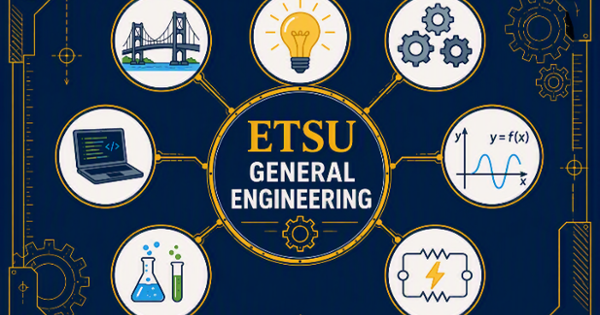
 The TTU-ETSU General Engineering program offers a flexible, interdisciplinary pathway
designed to prepare students for modern engineering careers through a strong foundation
in mathematics, science, and core engineering principles. Students explore multiple
engineering disciplines before selecting advanced coursework aligned with their interests,
gaining hands-on experience in labs, design projects, and collaborative problem‑solving.
With dedicated advising, supportive faculty, and connections to industry partners,
the program equips graduates with the technical knowledge and professional skills
needed to succeed in a wide range of engineering fields.
The TTU-ETSU General Engineering program offers a flexible, interdisciplinary pathway
designed to prepare students for modern engineering careers through a strong foundation
in mathematics, science, and core engineering principles. Students explore multiple
engineering disciplines before selecting advanced coursework aligned with their interests,
gaining hands-on experience in labs, design projects, and collaborative problem‑solving.
With dedicated advising, supportive faculty, and connections to industry partners,
the program equips graduates with the technical knowledge and professional skills
needed to succeed in a wide range of engineering fields.
The TTU-ETSU General Engineering Program at ETSU is accredited by the Engineering
Accreditation Commission of ABET, www.abet.org.

Program Educational Objectives:
Program educational objectives (PEOs) are broad statements that describe what graduates are expected to attain within a few years of graduation. The PEOs of TTU - ETSU General Engineering Program are to:
- Serve engineering needs in East Tennessee, Middle Tennessee, and broader markets, especially in companies which may have very few degreed engineers.
- Collaborate with non-engineers or discipline-specific engineers or both because of the general engineering background,
- Demonstrate career and professional growth as an engineer, and
As generalists, graduates of the Joint BSE Program will be able to work with non-engineers and discipline-specific engineers, such as electrical, industrial engineers, and mechanical. In some cases, the BSE graduate may be the only degreed engineer onsite, while in other cases, the BSE graduate will team with other engineers and technologists in a much larger technical setting.
As public universities in Tennessee, TTU and ETSU are committed to serving engineering needs in East and Middle Tennessee, as well as broader markets within Tennessee and neighboring states. Beyond the Southeast region, graduates of the Joint BSE Program will be able to work and contribute in national and international communities.
Every engineer should demonstrate career and professional growth through job progression, leadership, promotion, etc. and through activities such as pursuing engaging in graduate study, participating in continuing professional education, professional engineering licensure, and participating in professional engineering societies and other relevant organizations.
Student Outcomes:
Student outcomes (SO) describe what students are expected to know and be able to do by the time of graduation. These relate to the behaviors, knowledge, and skills that students acquire as they progress through the program. SOs are adopted from ABET and are as follows:
- an ability to identify, formulate, and solve complex engineering problems by applying principles of engineering, science, and mathematics.
- an ability to apply engineering design to produce solutions that meet specified needs with consideration of public health, safety, and welfare, as well as global, cultural, social, environmental, and economic factors.
- an ability to communicate effectively with a range of audiences.
- an ability to recognize ethical and professional responsibilities in engineering situations and make informed judgments, which must consider the impact of engineering solutions in global, economic, environmental, and societal contexts.
- an ability to function effectively on a team whose members together provide leadership, create a collaborative environment, establish goals, plan tasks, and meet objectives.
- an ability to develop and conduct appropriate experimentation, analyze and interpret data, and use engineering judgment to draw conclusions.
- an ability to acquire and apply new knowledge as needed, using appropriate learning strategies.