Best Practices
This page lists best practices for creating a Word document that anyone can access.
Download the Word Accessibility Best Practices Checklist for a handy reference at your fingertips.
File Properties & Metadata
- Set a clear, descriptive title for the document by going to File > Properties > Description rather than relying on the raw file name.
- Set the primary document language under the Advanced tab in Document Properties.
- Ensure security settings do not block screen readers or assistive technology.
Lists
- Use the List Styles under Paragraph in the Home tab.
- Lists break up complex or dense information.
Headings
Heading levels show content hierarchy. Heading levels start at 1 (highest) and decrease in importance (2, 3, etc.). Use Heading 1 for the title only.
- Use the Styles options in the Home tab to create headings.
- Use Heading 1 for the title only; nest H2, H3, and beyond by importance.
- Avoid writing important information in headers or footers.
Images & Alternative Text
Alternative text (or alt text) is a short image description read aloud by screen readers for visually impaired users.
- Limit alt text to 125 characters or fewer. If you have a long description, add the information as a caption below the image on the page, prefaced with "Image description."
- Mark purely decorative images: right click the image > View Alt Text > Mark as decorative.
Meaningful Links
Use meaningful, specific text that tells users where a link goes or what it does — even out of context. Do not use raw URLs, which are unformatted web addresses such as https://www.etsu.edu/accessibility. Screen readers read raw URLs out loud, character by character.
Avoid these generic terms:
- Click Here
- Link
- Info
- Video
Instead, describe the destination or action:
Instead of “https://www.etsu.edu/accessibility," use "Visit the ETSU Accessibility Website."
Instead of “Download the PDF," use "Download the 2024 Annual Report (PDF)."
Instead of “Watch this video," use "Watch the onboarding tutorial."
Tables
- If possible, find other ways to present data rather than using a table.
- Use tables only for data and not page layout.
- Don’t merge or split cells, or nest tables.
- Add a header row to a table via Design tab > Table Styles Options > Header row.
Color Contrast (Manual Check in Acrobat)
Don’t rely on color alone to convey information.
W3C’s Web Content Accessibility Guidelines (WCAG) Level AA sets minimum contrast (luminance difference) between text or icons and their background:
Minimum Thresholds (Level AA)
- Normal text: contrast ratio of at least 4.5:1.
- Large text and UI elements: a ratio of at least 3.0:1. (large text is 18 pt or 14 pt bold).
Check your colors with the WebAIM Color Contrast Checker.
Form Fields
Forms created in Word are not accessible. Use Acrobat Pro’s Prepare a Form tool or a form builder such as Dynamic Forms, Qualtrics, or Google Forms.
- Use Acrobat's Prepare a Form tool to auto-detect fields or add them manually.
- Form Fields must have descriptive labels and tooltips.
- Watch the training video How to Make PDF Forms Accessible for more information.
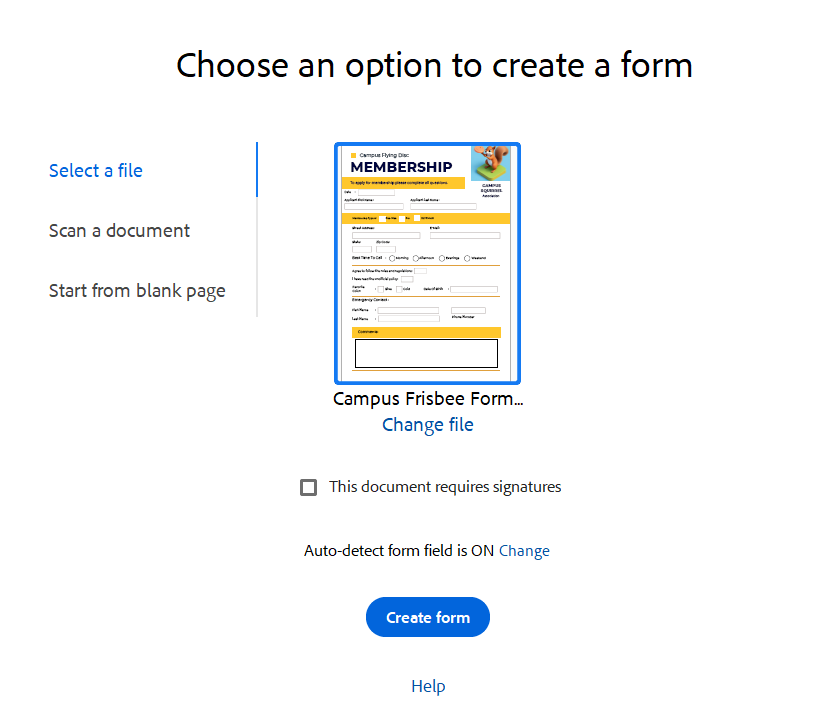
This screenshot shows Acrobat Pro's Prepare a Form tool.
Navigation
For documents over 10 pages, a table of contents works better than bookmarks for assistive
technology, since it links directly
to content.
Use your heading styles in the document, then to Insert Automatic TOC: Go to the References tab > Table of Contents > Custom Table of Contents > Check the box “Use hyperlinks instead of page numbers.” Save as an accessible PDF.
Saving as a PDF
When converting a Word document to PDF:
- Run Word’s checker and fix issues.
- Save as accessible PDF.
- Run Acrobat Pro’s accessibility checker.
- Correct any failures.
Note:
Acrobat Pro’s accessibility checker flags failures and requires manual checks to ensure the file is accessible. This step is required even if the Word file has already passed accessibility checks in its original software.
Acrobat Pro requires manual checks for color contrast and reading order.
If remediation issues can’t be fixed without changing the page content (text and images), address them outside of Acrobat: edit the original file in Word, re-export it as a PDF, and re-run the checker.
Resources
Use our training resources to help you create accessible content.